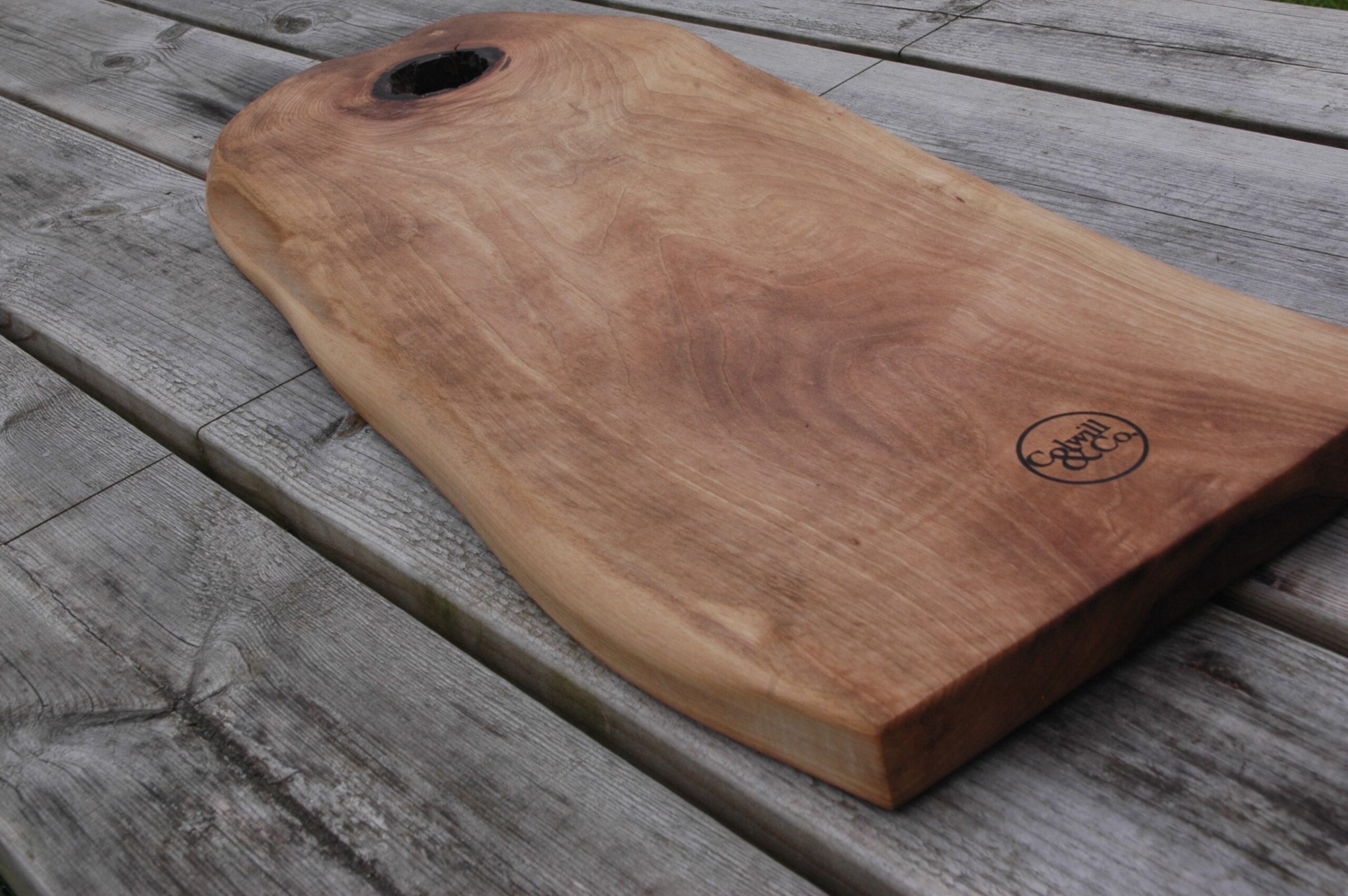
You will not be surprised that I am a fan of wooden chopping boards but the sheer number of reasons and the science behind my fandom may surprise you. And I use the science to make sure our chopping boards are as functional as they are beautiful.
What Your Chopping Board Needs To Do.
There are three main things a chopping board needs to do: look good, resist your knife without blunting it and be cleanable and hygienic. Let’s look at each in turn.
Looking Good.
I mean, it is made of wood. If you are after something beautiful then wood has to be on the list. I know, I would say that but come on, it is lovely stuff. You might also be surprised at the number of types of wood that can be used, including some that have previously been considered out of bounds. The open grained woods such as Ash and Oak have long been considered a no no for trapping bacteria in them but that only really applies to end grain boards that I do not recommend, for reasons that will become clear.
Take the Blade.
You need to be able to chop on a chopping board. Ceramics and glass not only sound awful if you try to but because they are harder than the blade they will also blunt your knife and leave shards of themselves or the knife blade in the food. Plastic can do the job but soon starts to look a bit shabby and to become a great shelter for dirt, stains and bacteria. You cannot refinish plastic so it will be time to get rid, maybe it will be recycled, maybe not. Wood on the other hand can be resanded if you so desire or just bear its scars with grace, adding to the boards unique character and, because of its amazing anti-bacterial qualities, without any impact on the hygiene of the board. Personally, I think a really well used chopping board looks fantastic, it is testimony to all the joy it has been part of. And if you do decide it has given of its all, it is completely recyclable.
Beyond Clean.
That brings me to the truly remarkable bit; just how hygienic wooden chopping boards are. It is all down to how they are made, not by me, by the tree.
Wood is hygroscopic. It absorbs and expels water until it reaches an equilibrium level determined by the humidity and temperature of its surroundings. In an average home this will mean a water content of around 8-10% of its saturated weight. And it will try to maintain this level throughout any single piece of wood, so that if one end or patch gets wet, it will rapidly shift the water around until it is uniformly distributed. This happens far more quickly than a damp plastic chopping board dries out. The bacteria that cause food poisoning are water borne and cannot survive at these moisture levels and so, if they end up on a board they are absorbed, moved into the center of the wood and then starved of the water they need to survive. The board is naturally sterilised while it is being used. This effect can even be seen with other stains. If you do happen to stain a wooden board, it is suprising how quickly the stain is dissipated.
Let’s compare this naturally sterilised effect to a plastic board. Here, the moisture and thus bacteria stays on the surface until it is washed off or killed with chemicals. Even when you put it in a dishwasher, many of the bacteria are merely thrown around the machine onto the rest of your washing-up. You may think a dish washer will kill off any bacteria and it will kill some but it is not hot enough to kill most bacteria, so it is reliant on the chemical action and effectively jet washing the surface. If your chopping board has become scored, plenty will survive inside the cuts on the board.
To keep this wood magic working we need to do a few basic things. Keep the board dry, do not leave it in the washing up and let it dry straight away with both sides exposed. We must not stop its ability to absorb and shed moisture, so no need to oil or varnish it and we should wash off grease and oils after use. Avoid boards that are made by gluing wood together. Wood glue is basically a plastic membrane between pieces of wood that stops the moisture from moving around.
So that is why our chopping boards have no finish other than being sanded really smooth, come with a stand to let them dry properly and are made from a single piece of wood.
Happy chopping.
OK, But Who Says?
I might be making all of this up just to promote my giant evil chopping board empire I guess. I am not though. I found out about this from a podcast featuring Dr Seri Robinson. She has an undergraduate degree in woodworking, a masters’ and PhD in Forest Science and is an Associate Professor of Wood Anatomy at Oregon State University. She also acts as a forensic expert witness in cases involving wood and wood science. However, as she herself points out, this is not based upon experiments that she has undertaken but on research that you can read about on Google Scholar. Thankfully, she has, so we don’t have to. But they are there, I looked.